- Engineering & Construction
- Environment
- Telecommunications
- Renewable energies
- Ventures
- Real estate
Respect. (from the lat. respectu) n. 1. respect; 2. consideration; high regard; 3. deference; compliance; veneration; 4. honour; worship; 5. relation; refererence...
We believe that everyone should be respected for their work, for their attitudes, opinions and options.
Rigor. (from the lat. rigore) n. 1. harshness; strength; 2.fig., severity; punctuality; accuracy.
There is no "more or less levelled", "more or less upright”, "more or less clean" or "more or less safe", but rather “levelled”, "upright”, "clean” and “safe". The rigour is reflected in our procedures, in time and in the rules to follow. In the light of moral and principles, being severe means being rigorous.
Passion. (from the lat. passione) n. 1. intense and usually violent feeling (affection, joy, hate, etc.) which hinders the exercise of impartial logic; 2. derived from a feeling; 3. great predilection; 4. partiality; 5. great grief; immense suffering...
Under the sign of passion – a text of the Portuguese poet Regina Guimarães – is our icon. Passion is to reveal great enthusiasm for something, favourable encouragement or opposite to something.
It is the sensibility transmitted by an architect or engineer through work.
Passion is the dedication to a project. Passion is a state of warm soul.
Loyalty. (from the lat. legalitate) n. the quality of being loyal; fidelity; sincerity.
Respect for the principles and rules that guide the honour and probity. Faithfulness to commitments and agreements undertaken, staunch character.
To remain loyal to the business partners because we depend on them and they depend on us.
Being trustworthy for being loyal.
Solidarity. (from the lat. solidare) n. 1. the quality of being solidary; 2. reciprocal responsibility among the members of a group, namely social, professional, etc.; 3. sense of sharing another’s suffering.
Being solidary is being a friend, offering our hand with genuine generosity and bringing joy and human warmth to those who, somehow, are marginalized. Being solidary is being more human. A solidary company is recognized as a fair and non-selfish company. A solidary company is a preferred choice in business. It is a more competitive company. Volunteering is a vehicle to solidarity. It is modern, fair, cultured, friend, it is a noble gesture of moral elevation.
Courage. (from the lat. coraticum) n. 1. bravery facing danger; intrepidity; to have audacity; 2. moral force before a suffering or setback; 3. [fig.] to input energy when performing a difficult task; perseverance...
Courage is essential in our life. Courage to face less pleasant situations when complex issues come up, not expecting random resolutions.
It is a value that we must highlight as opposed to the fearful, cowardly and laziness.
The courage to react to criticism not with an attitude of demotivation or sadness, but rather to search for the means and the action to overcome its own reason. This kind of courage, which is also an intellectual courage, is highly recommended.
Ambition. (from the lat. ambitione) n. 1. vehement desire of wealth, honours or glories; 2. expectation about the future; aspiration; 3. lust; greed…
Vehement desire to achieve a particular goal. Ambition not to resign ourselves. Ambition to take the best potential from ourselves. Ambition to deserve ourselves. Ambition to be athletes in our top-level competitive jobs. Ambition to beat our brands. Ambition to get the best deals with the maximum value, due to the high levels of proficiency and efficiency.
Esthetics. ESTHETICS (from the Greek aisthetiké, "sensitive") n.f. 1. Philosophy branch of philosophy that studies the beauty and nature of artistic phenomena; 2. author's own style, time, etc.; 3. harmony of shapes and colors, beauty; 4. set of techniques and treatments that aim to beautify the body.
We decided to build the company's economic foundations under a cultured, cosmopolitan and cool image. Because it is a charming state of being. Good taste because we are sustainable and we respect the planet. Good taste because we are sensitive. Good taste just because.
Responsibility. (from the lat respondere) n. the trait of being answerable to someone for something or being responsible for one's conduct; a form of trustworthiness.
We must be certain that, before a choice, we chose what is best for both of us and not just the best for each one. Each employee is responsible for his negotiated activity and co-responsible if the co-worker does not fulfil his own task, thus preventing the common goal. A team is a set of individuals - is a whole. In the business game, as in social or family contexts, everyone must comply with their own relative position and we shall not permit that one of ours fails to be in our team.
Negócios
For far too long, we have accepted the construction industry as a craft-based sector, prone to waste and uncertainty. This model has produced cities, jobs, and heritage, but it no longer fully addresses contemporary challenges.
The construction industry is at a point where business as usual is no longer prudent. Pressure on housing, labor shortages, unpredictable costs, the climate emergency, and slow bureaucratic processes force us to acknowledge the obvious: it’s not enough to simply build more. We must build differently.
To humanize construction is to put it at the service of people: the family waiting for a home, the student who can’t find a room, the developer who needs to know how much they’ll pay and when they can deliver, the workers who build under difficult conditions, and the cities that can no longer remain hostage to long and uncertain construction sites.
For far too long, we have accepted construction sites as places of artisanal, fragmented work—exposed to the weather, a succession of subcontractors, waste, and uncertainty. That model produced cities, jobs, and heritage, but it no longer fully addresses contemporary challenges. Industrialized construction represents a paradigm shift: moving much of what currently happens on-site to the factory, with more planning, quality, and control, and less improvisation.
Recent legislative developments confirm that the country is beginning to recognize this need. The revision of the Public Contracts Code and the announced regulations for industrialized construction may pave the way for greater scale, certification, and trust.
“INDUSTRIALIZED CONSTRUCTION REPRESENTS A PARADIGM SHIFT: MOVING MUCH OF WHAT CURRENTLY TAKES PLACE ON-SITE TO THE FACTORY, WITH MORE PLANNING, QUALITY, CONTROL, AND LESS IMPROVISATION”
This shift brings predictability to costs. In traditional construction, the initial price is all too often a fragile estimate. Design errors, omissions, incompatibilities between trades, on-site changes, and additional work turn budgets into risky ventures. In industrialized construction, the building is defined, coordinated, measured, and produced before it reaches the site. The cost is based on a tested, quantified, and repeatable system. You’re not contracting for a promise; you’re contracting for a controlled process.
It also brings predictability to the timeline. While the site is being prepared, different building components can be produced in the factory. They arrive on-site coordinated, finished or semi-finished, ready for assembly. The construction site becomes shorter, cleaner, and quieter. For investors, this means a reliable schedule; for the city, less disruption; for those who need a place to live, less waiting.
Building sustainably isn’t just about choosing materials with a smaller carbon footprint. It’s about designing better, measuring better, cutting better, storing better, and wasting less. The factory allows for precise material management, process tracking, and the reuse of scraps, reducing construction waste, transportation, corrections, and errors. Waste is no longer inevitable; it becomes a variable in design and production.
There is, however, a resistance that must be overcome and misconceptions that we have a duty to clarify—first and foremost, the idea that industrialized construction is temporary, repetitive, poor-quality, or lacking in identity. Combating these is just as important as developing technology. That is why we challenged architect Norman Foster and the engineering team at ARUP to work with us in defining an industrial construction concept, using the Living Lab as an accelerator and demonstrator: a full-scale laboratory where architecture, engineering, industry, and use come together to test and validate solutions. The industrial facility where this vision will be scaled up is designed by architect Álvaro Siza. In this way, the product that emerges from it will be better positioned to demonstrate that industrialization does not strip construction of its soul, but rather provides it with method, quality, and a future.
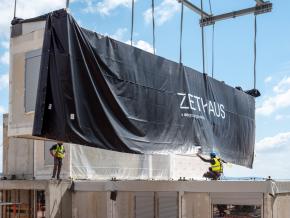
At dstgroup, through ZETHAUS, we transform this vision into industrial practice. The system combines structural 3D units—produced and finished in the factory—with 2D wall or floor panels, facades, and 3D infrastructure subsystems, such as bathrooms, ensuring flexibility and adaptability to different functional programs.
This approach shifts the center of gravity from the construction site to the factory, but it does not shift the focus of architecture: that remains human life. Industrialization also means dignifying work: reducing extreme physical exertion, improving safety, attracting young talent, integrating more women into the sector, and creating new professions.
Portugal has the resources, technical expertise, and ambition needed to lead this change. With its strong industrial base, engineering expertise, architectural creativity, and experience in exports, the country is well-positioned to turn this transition into a tangible advantage. For SMEs that take risks, innovate, and drive economic growth, industrialized construction paves the way for a new level of efficiency: greater productivity, cost control, reduced waste, on-time delivery, and a clear transformation of technical knowledge into value. More than just a technical evolution, it is about transforming specialized knowledge into economic value, contributing to the modernization of an essential sector of the Portuguese economy.
Industrializing construction does not mean turning homes into soulless objects. Perhaps it means, above all, accepting that every home begins before construction starts: in the design, the method, and the care; that technology must leave more room for life.
“THE FACTORY ALLOWS US TO MANAGE MATERIALS WITH PRECISION, TRACK PROCESSES, AND REUSE LEFTOVERS, REDUCING CONSTRUCTION DEBRIS, TRANSPORTATION, CORRECTIONS, AND ERRORS”
Opinion Piece by Luís Trigueiros Reis, Architect at ZETHAUS