- Engineering & Construction
- Environment
- Telecommunications
- Renewable energies
- Ventures
- Real estate
Respect. (from the lat. respectu) n. 1. respect; 2. consideration; high regard; 3. deference; compliance; veneration; 4. honour; worship; 5. relation; refererence...
We believe that everyone should be respected for their work, for their attitudes, opinions and options.
Rigor. (from the lat. rigore) n. 1. harshness; strength; 2.fig., severity; punctuality; accuracy.
There is no "more or less levelled", "more or less upright”, "more or less clean" or "more or less safe", but rather “levelled”, "upright”, "clean” and “safe". The rigour is reflected in our procedures, in time and in the rules to follow. In the light of moral and principles, being severe means being rigorous.
Passion. (from the lat. passione) n. 1. intense and usually violent feeling (affection, joy, hate, etc.) which hinders the exercise of impartial logic; 2. derived from a feeling; 3. great predilection; 4. partiality; 5. great grief; immense suffering...
Under the sign of passion – a text of the Portuguese poet Regina Guimarães – is our icon. Passion is to reveal great enthusiasm for something, favourable encouragement or opposite to something.
It is the sensibility transmitted by an architect or engineer through work.
Passion is the dedication to a project. Passion is a state of warm soul.
Loyalty. (from the lat. legalitate) n. the quality of being loyal; fidelity; sincerity.
Respect for the principles and rules that guide the honour and probity. Faithfulness to commitments and agreements undertaken, staunch character.
To remain loyal to the business partners because we depend on them and they depend on us.
Being trustworthy for being loyal.
Solidarity. (from the lat. solidare) n. 1. the quality of being solidary; 2. reciprocal responsibility among the members of a group, namely social, professional, etc.; 3. sense of sharing another’s suffering.
Being solidary is being a friend, offering our hand with genuine generosity and bringing joy and human warmth to those who, somehow, are marginalized. Being solidary is being more human. A solidary company is recognized as a fair and non-selfish company. A solidary company is a preferred choice in business. It is a more competitive company. Volunteering is a vehicle to solidarity. It is modern, fair, cultured, friend, it is a noble gesture of moral elevation.
Courage. (from the lat. coraticum) n. 1. bravery facing danger; intrepidity; to have audacity; 2. moral force before a suffering or setback; 3. [fig.] to input energy when performing a difficult task; perseverance...
Courage is essential in our life. Courage to face less pleasant situations when complex issues come up, not expecting random resolutions.
It is a value that we must highlight as opposed to the fearful, cowardly and laziness.
The courage to react to criticism not with an attitude of demotivation or sadness, but rather to search for the means and the action to overcome its own reason. This kind of courage, which is also an intellectual courage, is highly recommended.
Ambition. (from the lat. ambitione) n. 1. vehement desire of wealth, honours or glories; 2. expectation about the future; aspiration; 3. lust; greed…
Vehement desire to achieve a particular goal. Ambition not to resign ourselves. Ambition to take the best potential from ourselves. Ambition to deserve ourselves. Ambition to be athletes in our top-level competitive jobs. Ambition to beat our brands. Ambition to get the best deals with the maximum value, due to the high levels of proficiency and efficiency.
Esthetics. ESTHETICS (from the Greek aisthetiké, "sensitive") n.f. 1. Philosophy branch of philosophy that studies the beauty and nature of artistic phenomena; 2. author's own style, time, etc.; 3. harmony of shapes and colors, beauty; 4. set of techniques and treatments that aim to beautify the body.
We decided to build the company's economic foundations under a cultured, cosmopolitan and cool image. Because it is a charming state of being. Good taste because we are sustainable and we respect the planet. Good taste because we are sensitive. Good taste just because.
Responsibility. (from the lat respondere) n. the trait of being answerable to someone for something or being responsible for one's conduct; a form of trustworthiness.
We must be certain that, before a choice, we chose what is best for both of us and not just the best for each one. Each employee is responsible for his negotiated activity and co-responsible if the co-worker does not fulfil his own task, thus preventing the common goal. A team is a set of individuals - is a whole. In the business game, as in social or family contexts, everyone must comply with their own relative position and we shall not permit that one of ours fails to be in our team.
Business
From reducing waste to speeding up construction, companies in the sector argue that industrialization can transform the way buildings are constructed in Portugal and help address the housing shortage.
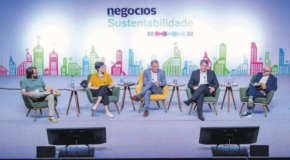
The need to build more housing, faster, and more sustainably is accelerating the shift toward industrialized construction in Portugal. This was the main conclusion of the workshop “More Housing, Faster: Industrialized Construction,” held as part of the 20|30 Business Sustainability Conference and moderated by Tiago Carrilho, head of Knowledge and Training at BCSD Portugal. The workshop brought together companies and industry experts to discuss solutions capable of addressing the current housing crisis.
Bárbara Fachada, an architect at dstgroup, acknowledges that the sector currently faces “slow processes, a shortage of skilled labor, rising costs, low productivity, and enormous environmental pressure.” Despite this, “we continue to build using methods similar to those from several decades ago,” she lamented.
She presented the Z-House project, developed by the group, which focuses on the industrialization of construction through factory-produced components that are later assembled on-site. “We really need not just an evolution, but a re-evolution,” she asserted.
According to the expert, about 90% of the construction process is transferred to an industrial setting, which helps reduce waste, speed up construction, and improve working conditions. As an example, she highlighted a student residence in Felgueiras, designed and built in just seven months.
The shift toward industrialization is also transforming the way building materials are produced. Rui Oliveira, director of Saint-Gobain Solutions Portugal, presented a mechanized system for applying screed that, as he explained, allows the same surface to be completed “four times faster” compared to traditional methods. In addition to reducing construction time, Rui Oliveira emphasized environmental and operational benefits. “We’re talking about eliminating about one million bags per year,” he noted, adding that this is accompanied by a decrease in material waste, a reduced need for skilled labor, and less space required on the construction site. “Time is what we lack, and we can’t stretch it any further,” he noted, adding that industrialization will be inevitable to increase the sector’s efficiency in the country.
Daniel Granjo, CEO of KREAR, also believes that industrialization is no longer just a trend but is increasingly becoming “a factor in competitiveness.” The company, which focuses on industrialized housing solutions, is developing projects in areas as diverse as affordable housing, tourism, hospitals, and research facilities.
He highlighted the efficiency gains achieved in completed projects, citing an affordable rental development in Vila Nova de Gaia—comprising three buildings and 90 apartments—as an example. Assembly of the first building took 47 days, the second 40, and the third just 33 days.
Even so, he cautions that “industrialization requires much greater discipline upstream, in the design and planning phases,” which makes the synchronization between factory production and site preparation one of the decisive factors in accelerating timelines.
For Tiago Carrilho, Bárbara Fachada, Rui Oliveira, Daniel Granjo, and Nuno Fideles, industrialized construction can accelerate the response to the housing crisis by reducing lead times, waste, and costs, while also improving the predictability of construction projects and the sector’s sustainability.
Building Like Lego
The speakers agree that the equation is positive and that, in addition to reducing construction timelines and increasing competitiveness, industrialized construction is a direct response to the growing environmental, social, and governance requirements associated with sustainability.
“This is a major solution to our need to quickly build housing,” reiterated Nuno Fideles, Head of Sustainability at Savills. On the environmental front, he highlighted the reduction in embodied carbon, waste, and energy consumption on construction sites. From the perspective of the circular economy, he compared this model to “building with Lego,” since it becomes possible to dismantle buildings at the end of their life cycle and reuse components. Nuno Fideles also emphasized the social impacts of industrialization, particularly in improving working conditions.